
Data is the New Steel
AI sovereignty depends on resource sovereignty–but what's in it for local communities?

Editor’s Note: This report includes contributions from Hale Strategic board members Lyric Hughes Hale, Mark P Mills, and Mark Roeder.
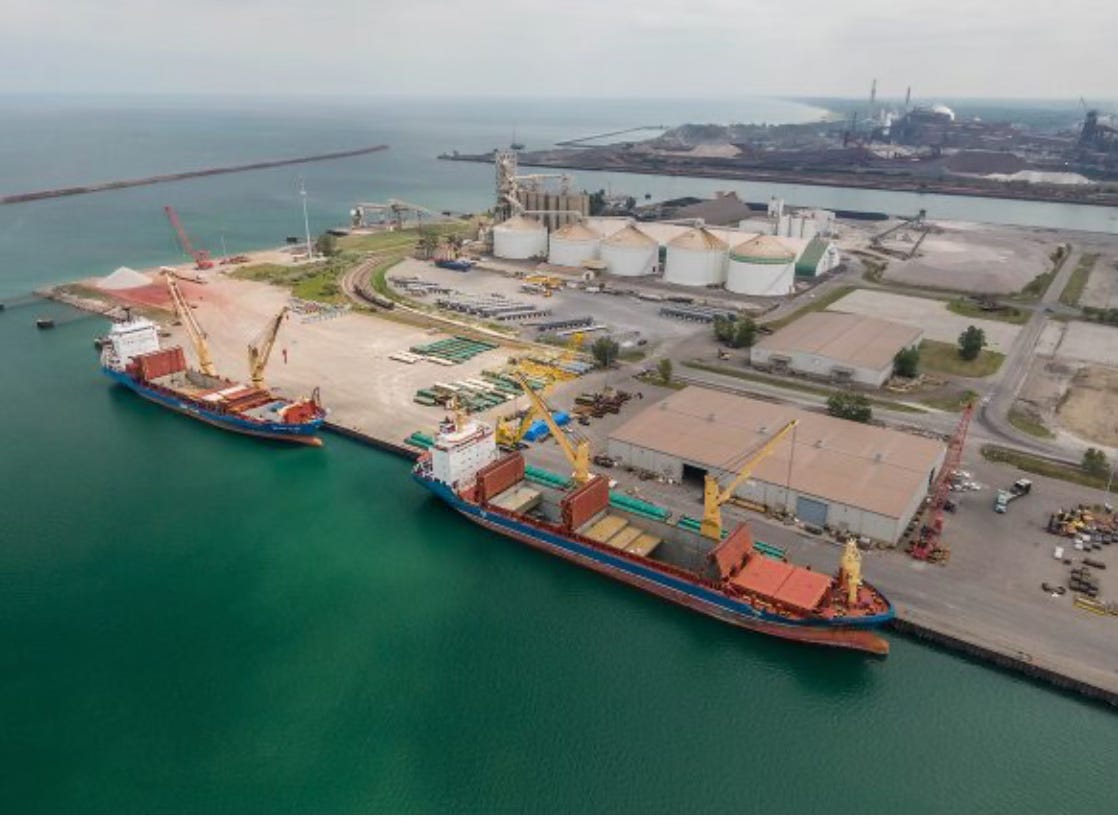
In Northwest Indiana, the bargain between heavy industry and local communities has always been complicated. Steel mills brought noise, pollution, land-use conflict, environmental damage, and the daily reality of living beside the machinery of American industrial power. They also brought jobs, tax revenue, municipal borrowing capacity, ports, infrastructure, and a sense that local sacrifice served a larger national purpose, especially during World War II.
The steel corridor along Lake Michigan was not built in that location by accident. Bethlehem Steel purchased thousands of acres in Porter County and built what became the Burns Harbor steel plant, which began operations in 1964, one of the most important integrated steel facilities in the United States. The plant helped anchor the Port of Indiana and the incorporation of the Town of Burns Harbor. Decades later, Burns Harbor’s annexation of part of the steel property gave the town additional tax revenue and borrowing power, allowing it to purchase and share the Bethlehem sewage treatment plant with the mill.[1] The result was a familiar industrial bargain: local communities absorbed the burdens of heavy industry, in return for jobs and lower property taxes along the Indiana lakefront.
❝ That old industrial bargain is now being rewritten for the age of artificial intelligence.
Burns Harbor has already confronted this question directly. In August 2024, the town’s Advisory Plan Commission considered a proposed technology district and data center rezoning. The minutes show residents raising concerns about building height, setbacks, noise, water pressure, power demand, fire protection, taxes, proximity to residential neighborhoods, and the Indiana Dunes National Park. One resident summarized the dilemma clearly: “Burns Harbor indeed became a town because of the steel mill, but further industrialization is not the only option before this commission and does not have to be your legacy to your community.”[2]
Data centers are the new steel mills. They are strategic, capital-intensive, power-hungry facilities whose importance extends far beyond the towns in which they are located. But unlike steel mills, they have arrived under the language of clean technology, cloud computing, and digital transformation. Communities have quickly begun to discover that these facilities behave less like office parks and more like industrial infrastructure. The comparison is not exact, but is useful.
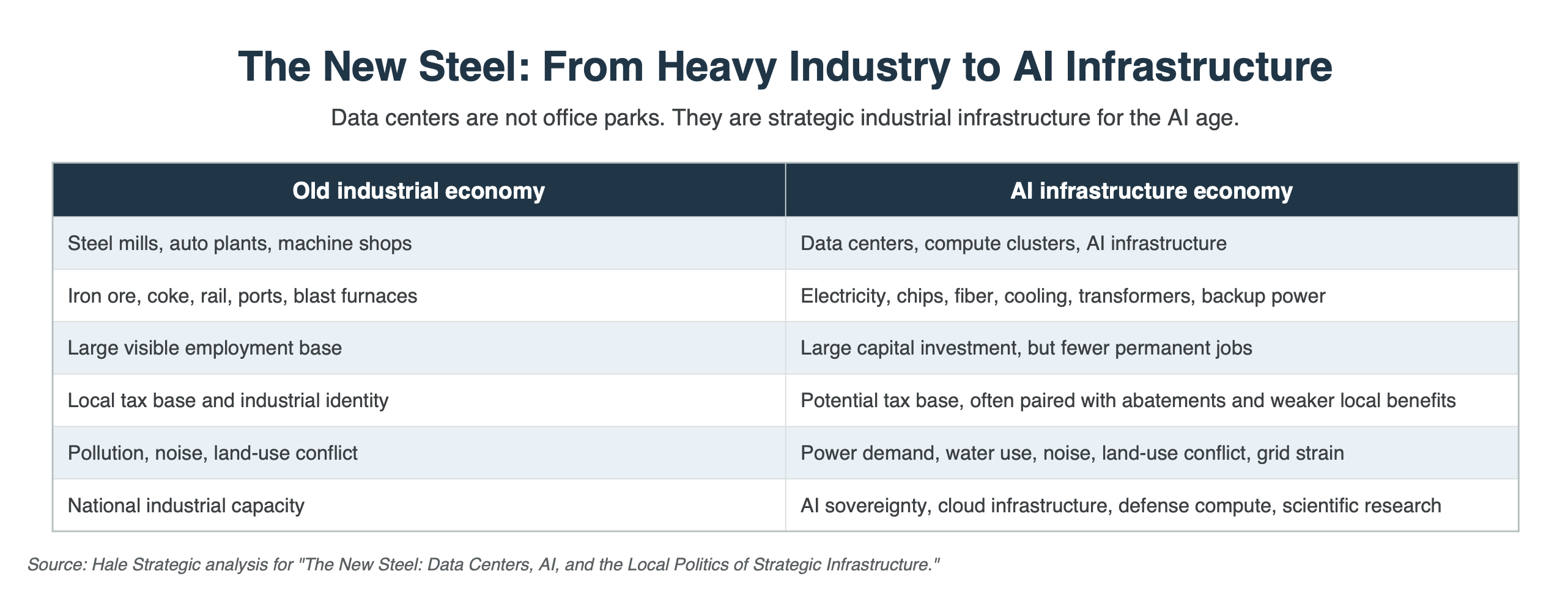
Artificial intelligence is often described as weightless, digital, and borderless. It is none of those things. AI’s physical stack rests on electricity, water, land, semiconductors, cooling systems, fiber networks, backup power, transformers, and political permission.
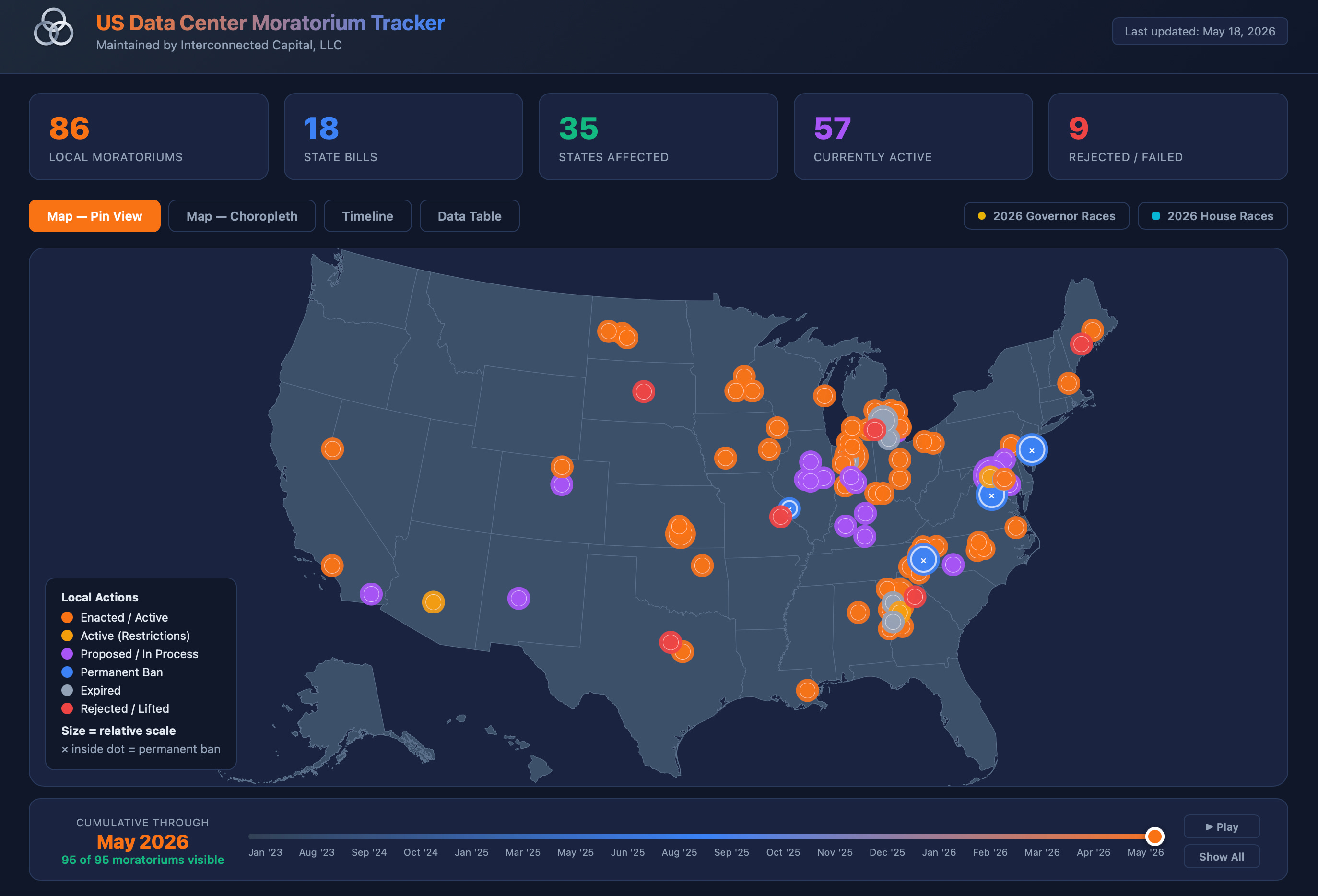
Interconnected Capital’s new US Data Center Moratorium Tracker shows that the next bottleneck in the AI race may not be algorithms or venture capital, but the communities being asked to host the infrastructure of national power.[3]
❝ AI may seem weightless, but it depends on very physical infrastructure: land, electricity, cooling, fiber networks, construction and skilled trades. These are precisely the kinds of systems the Midwest was built to support. By locating AI infrastructure there, America can reconnect innovation with production rather than leaving the future concentrated only on the coasts. — Mark Roeder
The United States cannot win the AI race without building the physical infrastructure of AI. But if data centers are permitted as ordinary commercial real estate rather than strategic industrial infrastructure, the backlash will grow. Communities are not simply being anti-technology. They are asking a legitimate question: if data centers are essential to national competitiveness, why are the costs local and the benefits remote?
Ten Principles for the AI Industrial Compact
1. Data centers are not office parks. They are the factories of the AI age
The first mistake is conceptual. Data centers are often discussed as part of the digital economy, but their footprint is industrial. They are closer to steel mills, chemical plants, ports, rail hubs, and power stations than to suburban office parks.
Like steel mills, data centers require a supply chain. Instead of iron ore, coke, and lake ports, they need chips, servers, rare earths, copper, transformers, cooling systems, backup power, and fiber. Like steel mills, they require enormous fixed investment and they reshape the communities around them.
But the political bargain is weaker. Steel mills employed large numbers of people and created visible industrial ecosystems. Data centers require vast capital investment, but relatively few permanent workers once construction is complete. That does not mean they lack value. They are essential to cloud computing, AI development, cybersecurity, finance, logistics, healthcare, defense systems, and scientific research. But it does mean the local benefit is less obvious.
A town asked to host a steel plant could see the jobs, the port, the rail lines, the tax base, and the industrial identity. A town asked to host a data center may see higher electricity demand, construction traffic, humming equipment, water withdrawals, backup generators, and tax abatements, but not a comparable employment base. That asymmetry is at the heart of the backlash.
❝ The AI economy is being built faster than the civic bargain needed to sustain it.
2. The data center revolt is a warning signal
Interconnected Capital’s tracker matters because it turns anecdotes and local news reporting into a map. Across the country, local governments are imposing moratoriums, considering restrictions, or rejecting proposed facilities. The tracker records municipal, county, and state-level construction bans and moratoriums affecting data center development, and other state-level analyses have found that local restrictions are gaining traction even as statewide moratorium bills have advanced more slowly.[3][4]
This is not simply a NIMBY problem; it is a legitimacy problem. The AI economy is being built faster than the civic bargain needed to sustain it. The politics are becoming bipartisan because the concerns are local and tangible: electricity bills, water use, land use, noise, grid reliability, tax subsidies, and distrust of large technology companies. A farmer worried about groundwater, a homeowner worried about noise, a retiree worried about electric bills, and a local official worried about emergency services may have very different politics, but they can all converge against a data center project.
Denver’s one-year data center moratorium, approved in May 2026, is a useful example of how quickly this issue has moved from specialized infrastructure policy into ordinary city politics. The stated concerns were not abstract hostility to technology, but water and energy demand, resource conservation, and community impact.[5]
3. The electricity issue is the central bottleneck
Data centers are becoming one of the most important new sources of electricity demand in the United States. The Department of Energy’s Lawrence Berkeley National Laboratory report found that US data centers consumed about 4.4% of total US electricity in 2023 and could consume 6.7% to 12% by 2028, depending on growth scenarios. The report also estimated that data center electricity use rose from 58 TWh in 2014 to 176 TWh in 2023 and could reach 325 to 580 TWh by 2028.[6] That is not a marginal load. It is a structural change in US electricity demand.
❝ The central energy challenge for the great AI data center expansion is not whether the US can supply the quantities of electricity needed, and importantly at the velocity needed, because the engineering and resource capabilities are more than sufficient. The central challenge resides in permissions and politics, and in breaking free from the shackles of a no-growth grid mindset. What that means is already in play; the market is overweight in pursuit of America’s astonishing capability to supply natural gas, and the use of every class of machine that can convert those molecules into electrons, from all classes of turbines and big engines to even gas-fired steam boilers.—Mark P Mills
For years, American electricity demand was relatively flat. The AI boom has arrived just as the grid is also being asked to support electrification, reshoring, electric vehicles, heat pumps, advanced manufacturing, and defense-related industrial production. Data centers are therefore competing for capacity in a system that is already under stress.
The political question is not whether data centers should have electricity. The question is: who pays for the generation, transmission, substations, transformers, backup systems, and reliability services needed to serve them?
If the answer is ordinary ratepayers, the backlash will intensify. A household should not be asked to subsidize the grid upgrades required by a hyperscale compute facility. Large-load customers should bring, contract for, or pay for the firm power and grid infrastructure they require. This principle is central to the HSRI policy framework:
❝ Bring your own power, or pay for the power you require.
4. Nuclear is a promising longer-term solution
The data center boom is already changing the politics of nuclear energy. Microsoft and Constellation signed a 20-year power purchase agreement tied to restarting Three Mile Island Unit 1, now renamed the Crane Clean Energy Center. Constellation has said the project could add approximately 835 MW of carbon-free power to the grid, subject to regulatory approvals.[7]
Google has also signed an agreement with Kairos Power to purchase nuclear energy from multiple small modular reactors, with a path to deploy up to 500 MW of advanced nuclear capacity by 2035.[8]
This is a major shift. For years, nuclear power was discussed largely in terms of climate policy, baseload electricity, and decarbonization. Now it is also being discussed in terms of AI competitiveness.
Data centers need reliable, round-the-clock electricity. Wind and solar can contribute, especially with storage and grid integration, but hyperscale AI loads require firm power. Nuclear, geothermal, hydro, gas with carbon capture, long-duration storage, and advanced grid management will all be part of the discussion.
But nuclear does not solve every problem. A nuclear-supplied data center still needs transmission, cooling, land, security, emergency planning, and public trust. Restarting a nuclear plant or building advanced reactors takes time, regulatory approval, financing, and local acceptance. Nuclear can be part of the answer, especially for firm clean power, but it cannot immediately solve siting, water, cost, and community consent issues.
❝ Nuclear can help solve the power problem. It cannot solve the political bargain problem.
5. Needed: A bridge over troubled waters
Electricity may be the dominant constraint, but water is often the issue that makes a data center politically toxic. Some data centers use evaporative cooling, which can reduce electricity use but consume significant water. Others use closed-loop, liquid, or air-cooling systems that can reduce water demand but increase power needs or capital cost. The right technology depends on climate, water stress, power availability, and the type of computing load.
The policy principle should be simple: data centers should not use scarce drinking water for private compute in water-stressed regions unless they meet strict standards, use recycled or non-potable water, or adopt water-minimizing cooling systems.
This is not anti-growth, it is basic resource realism. A data center in a water-abundant industrial corridor is different from a data center in a drought-prone region with stressed aquifers. A facility using recycled wastewater is different from one drawing potable water. A facility with transparent reporting is different from one whose water use is hidden behind confidentiality claims.
This is also why the Great Lakes region will become central to the data center debate. Water abundance may be a strategic advantage, but it is not a blank check. Communities that steward one of the world’s most important freshwater systems will expect transparency, conservation, and enforceable limits.[9]
❝ For Hale Strategic, this is precisely the point: AI infrastructure is inseparable from resource infrastructure.
6. Noise and land use turn abstract AI concerns into daily life
Noise may sound like a minor issue compared with electricity and water, but it is often what turns local concern into organized opposition. Cooling systems, fans, transformers, generators, and construction activity can affect nearby residents in a direct and continuous way.
Data centers can also change land-use patterns. A project may be proposed near homes, schools, farms, wetlands, or conservation areas because the site has access to transmission or fiber. The developer sees infrastructure. Residents see disruption.
This is where higher, clearer standards could prevent unnecessary conflict. Setbacks, acoustic design, sound walls, generator-testing limits, real-time monitoring, landscaping, building design, and enforceable penalties should be part of the permitting process.
7. The Midwest should not miss the AI opportunity, but it should not accept a bad bargain
For Hale Strategic, the Midwest angle is essential. The old industrial Midwest already has many of the assets the AI economy needs: power infrastructure, water access in some regions, rail and port corridors, brownfields, engineering talent, manufacturing capacity, universities, and a history of hosting strategic industry.
This creates a major opportunity. Former steel sites, retired coal plants, nuclear-adjacent sites, brownfields, industrial parks, and underused manufacturing corridors could become preferred locations for the infrastructure of the AI age. As Mark Roeder argues, the opportunity is not merely to host data centers, but to build an AI industrial ecosystem around them, linking compute infrastructure to robotics, advanced manufacturing, power equipment, university research, technical training, and skilled trades. Done well, the Midwest would not become another Silicon Valley. It would become the industrial backbone of the AI age.
But this should not mean a race to the bottom. If communities compete by offering tax abatements, cheap power, weak water rules, and minimal disclosure, they may win the project but lose the public. The better Midwest strategy is to offer speed and certainty in exchange for standards and benefits, including jobs and training.
A data center that locates on a brownfield industrial site, pays for its grid upgrades, uses non-potable or recycled water, meets noise standards, contributes to local tax revenue, and supports workforce development should move quickly through permitting. A data center that shifts costs to ratepayers, hides water use, demands abatements, and creates few local benefits including employment should not. A new industrial compact is being formulated in the shadows of closed factories and broken promises.
8. The community benefit model should be rebuilt for strategic infrastructure
The Northwest Indiana example points toward a practical solution. Communities will accept industrial burdens when they believe the benefits are real, local, and lasting. For data centers, that means moving beyond vague promises of innovation and economic development. Host communities should receive a clear bargain.
That bargain should include:
A local tax floor so data centers do not erase their public benefit through excessive abatements.
Ratepayer protection so households and small businesses do not pay for hyperscale grid upgrades.
Water transparency with public reporting of withdrawals, consumption, source, and recycling.
Noise standards with enforceable limits and independent monitoring.
Infrastructure contributions for roads, substations, emergency services, water systems, and broadband.
Workforce commitments tied to local technical colleges, electricians, engineers, cybersecurity programs, and operations jobs.
Clawbacks if promised investment, tax revenue, or community benefits do not materialize.
Cybersecurity and resilience standards, especially for facilities supporting critical infrastructure, healthcare, finance, defense, or government functions.
This should not be framed as an industrial penalty but as as a condition of political legitimacy and support.
❝ If data centers are strategic infrastructure, host communities should be treated as strategic partners.
9. A national law may be necessary, but federal override would be a mistake
The national security argument for data center buildout is real. The United States cannot lead in AI without domestic compute capacity. If local moratoriums continue to spread, the cumulative effect could weaken US competitiveness, slow AI deployment, raise costs, and push infrastructure into less suitable locations.
But a blunt federal override of local authority would likely deepen mistrust. It would confirm the fear that communities are being asked to absorb costs for the benefit of distant technology companies and national-security planners.
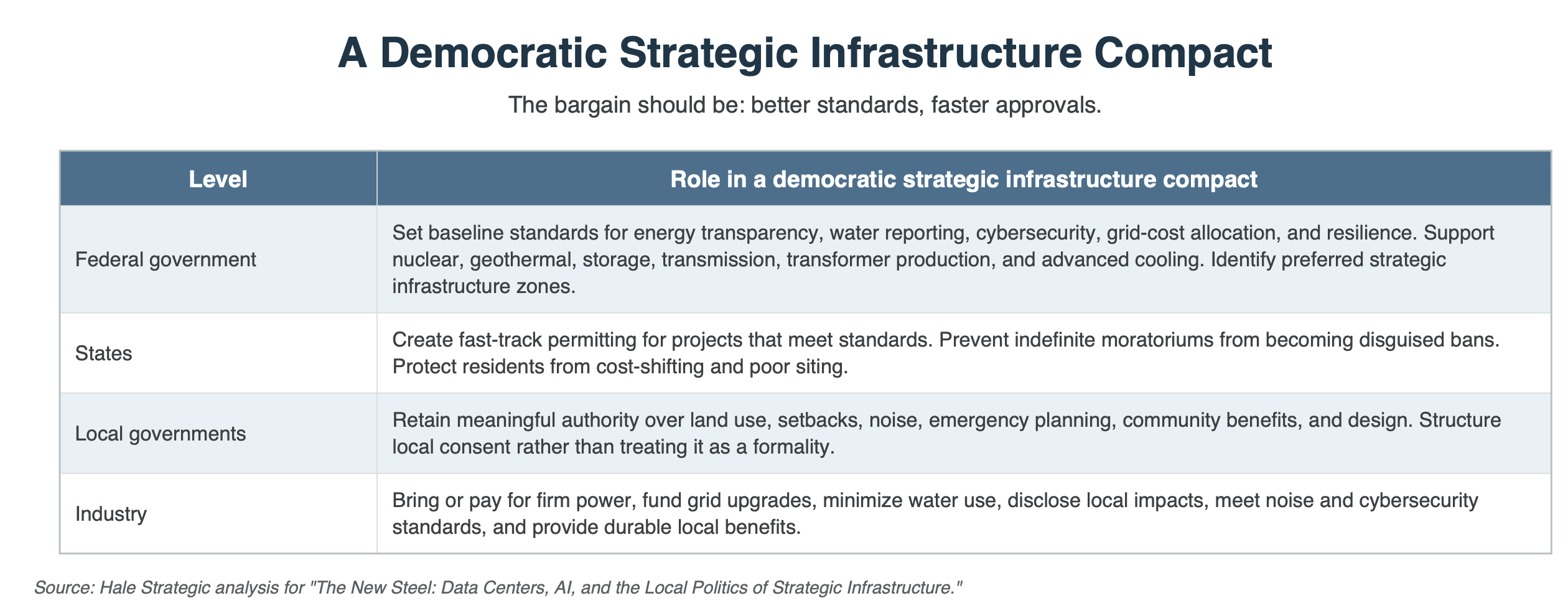
A better approach would be a federal-state-local compact. The federal government should set baseline standards for energy transparency, water reporting, cybersecurity, grid-cost allocation, and critical infrastructure resilience. It should support nuclear, geothermal, storage, transmission, transformer production, and advanced cooling technologies. It should also identify preferred strategic infrastructure zones, especially brownfields, retired coal sites, nuclear-adjacent areas, military-adjacent secure compute zones, and industrial corridors.
States should create fast-track permitting for projects that meet these standards. They should prevent indefinite moratoriums from becoming disguised bans, but they should also protect residents from cost-shifting and poor siting.
Local governments should retain meaningful authority over land use, setbacks, noise, emergency planning, community benefits, and design. Local consent should not be performative, it should be structured. The bargain should be: better standards, faster approvals.
Sidebar: China Is Building Compute as Strategic Infrastructure
China is already treating compute as a pillar of national infrastructure. As reported by Trivium, in May 2026, Vice Premier Ding Xuexiang toured data centers in Beijing, Hebei, and Inner Mongolia to push China’s National Unified Computing Power Network, a state-led effort to build a self-sufficient data center grid. Inner Mongolia alone plans RMB 731.1 billion in computing infrastructure investment and already accounts for roughly 17% of China’s national AI compute capacity.[9] The United States cannot and should not emulate China’s command model. But it does need a democratic answer to it.
While US data center development is increasingly shaped by local moratoriums, zoning disputes, water concerns, and ratepayer politics, China is moving in the opposite direction: treating compute as a national infrastructure priority.
10. Technology is part of the solution, but not the whole solution
Improved technology can reduce the burden. More efficient chips, advanced liquid cooling, waterless systems, heat reuse, battery storage, AI-driven load shifting, modular nuclear, geothermal power, and grid-enhancing technologies can all help.
But technology alone will not solve the political problem. A quieter, more efficient data center can still raise electricity prices if grid costs are socialized. A nuclear-powered facility can still face opposition if it receives tax breaks without local benefits. A water-efficient project can still fail if residents believe the process was opaque.
The United States needs better technology, but it also needs better governance. This is the larger lesson for AI policy. The race is not only about who builds the best model. It is about who can build the physical, institutional, and civic infrastructure to sustainably support the model at scale.
Conclusion: From backlash to bargain
The United States does not lack capital, engineers, or ambition. What it increasingly lacks is a credible process for building strategic infrastructure in places where people actually live. In the Midwest, which is an ideal location from a logistical and resource standpoint, there is also history within living memory of industrial policies and practices that did lasting, quantifiable harm to communities and workers. Local concerns need a social and political, not just economic compact:
The data center backlash is not a rejection of AI. It is a warning that the AI economy is being built faster than the civic bargain needed to sustain it. Northwest Indiana’s steel towns offer a useful lesson. Communities will tolerate industrial burdens when they believe the benefits are real, local, and lasting.
Data centers are the new steel. They are the factories of the AI age. They will shape American competitiveness, defense capacity, scientific research, healthcare systems, financial markets, and the future of work. But they are not weightless. They require power, water, minerals, land, cooling, chips, and trust.
AI sovereignty depends on resource sovereignty. And resource sovereignty depends on whether America can build again without breaking faith with the communities asked to host the future. Especially in the Midwest, the promises of globalization were not kept. Trust was broken, and must be rebuilt as the US competes with China, whose government can build strategic infrastructure without asking for the consent of the communities affected by it. That is not a model to emulate, but it is a competitive reality the United States must answer in its own democratic way.
Footnotes & Sources
[1] Indiana Historical Bureau, Legacy of Steel / Burns Harbor Steel Plant, State of Indiana. The historical marker notes that Bethlehem Steel purchased 3,300 acres in Porter County, began Burns Harbor operations in 1964, helped spur the creation of the Indiana Dunes National Lakeshore in 1966, and was key to building the Port of Indiana and incorporating the Town of Burns Harbor in 1967. See also Town of Burns Harbor, Local History, which notes that the town’s 1998 annexation of about 1,000 acres of the Burns Harbor plant increased tax revenue and borrowing power, enabling the purchase of the Bethlehem sewage treatment plant in 2001.
https://www.in.gov/history/state-historical-markers/find-a-marker/find-historical-markers-by-county/indiana-historical-markers-by-county/legacy-of-steel-burns-harbor-steel-plant/
https://www.burnsharbor-in.gov/203/Local-History
[2] Town of Burns Harbor, Advisory Plan Commission Minutes of Monday, August 5, 2024, approved September 9, 2024. The minutes record discussion of a proposed data center/technology district, including concerns over building height, setbacks, noise, water pressure, power demand, fire protection, taxes, proximity to residential neighborhoods, and nearby Indiana Dunes National Park.
https://www.burnsharbor-in.gov/AgendaCenter/ViewFile/Minutes/_08052024-906
[3] Interconnected Capital, US Data Center Moratorium Tracker — 2026, accessed May 19, 2026. The tracker maps municipal, county, and state-level construction bans and moratoriums affecting data center development in the United States.
https://www.interconnectedcapital.com/research/data-center-moratoriums
[4] MultiState, State Data Center Moratoriums Stall Despite Local Success, March 13, 2026. MultiState reported that state-level data center moratorium bills had been introduced in 11 states in 2026, while local construction bans were gaining more traction.
https://www.multistate.us/insider/2026/3/13/local-data-center-regulations-gain-ground-as-state-bills-falter
[5] Axios Denver, Denver passes one-year data center moratorium, May 19, 2026. Axios reported that Denver’s City Council approved a one-year moratorium on new data center developments and construction amid concerns over water and energy demand.
https://www.axios.com/local/denver/2026/05/19/denver-data-center-moratorium-approved
[6] Lawrence Berkeley National Laboratory, Berkeley Lab Report Evaluates Increase in Electricity Demand from Data Centers, January 15, 2025; see also US Department of Energy, DOE Releases New Report Evaluating Increase in Electricity Demand from Data Centers, December 20, 2024. The report found that US data centers consumed about 4.4% of total US electricity in 2023 and could consume 6.7% to 12% by 2028.
https://newscenter.lbl.gov/2025/01/15/berkeley-lab-report-evaluates-increase-in-electricity-demand-from-data-centers/
https://www.energy.gov/articles/doe-releases-new-report-evaluating-increase-electricity-demand-data-centers
[7] Constellation Energy, Constellation to Launch Crane Clean Energy Center, Restoring Jobs and Carbon-Free Power to The Grid, September 20, 2024. Constellation announced a 20-year power purchase agreement with Microsoft to restart Three Mile Island Unit 1 as the Crane Clean Energy Center, adding approximately 835 MW of carbon-free energy to the grid, subject to regulatory approvals.
https://www.constellationenergy.com/news/2024/Constellation-to-Launch-Crane-Clean-Energy-Center-Restoring-Jobs-and-Carbon-Free-Power-to-The-Grid.html
[8] Google, New nuclear clean energy agreement with Kairos Power, October 14, 2024. Google announced an agreement to purchase nuclear energy from multiple small modular reactors to be developed by Kairos Power, with the first reactor targeted by 2030 and additional deployments through 2035, enabling up to 500 MW of 24/7 carbon-free power.
https://blog.google/company-news/outreach-and-initiatives/sustainability/google-kairos-power-nuclear-energy-agreement/
[9] Crain’s Chicago Business Forum: This piece is useful background for the emerging debate over whether the Great Lakes region’s freshwater access could become a strategic advantage for data center development, and why water abundance still requires governance, transparency, and public trust. AI’s Expanding Footprint comes with a big thirst for water
[10] Trivium China, Ding Xuexiang Tours Data Centers to Push Compute Buildout, May 19, 2026. Trivium reported that Vice Premier Ding Xuexiang toured data centers in Beijing, Hebei, and Inner Mongolia to push China’s National Unified Computing Power Network, and that Inner Mongolia plans RMB 731.1 billion in computing infrastructure investment and accounts for roughly 17% of China’s national AI compute capacity.
https://triviumchina.com/2026/05/19/ding-xuexiang-tours-data-centers-to-push-compute-buildout/

